TL;DR - The Arabian horse is the oldest documented horse breed, shaped over 3,000 years by Bedouin tribes. Recognizable by its concave head, large eyes, high tail carriage and 5 lumbar vertebrae (instead of 6), it combines endurance, elegance and a sensitive character. Expect to pay €5,000 to €30,000 for a riding horse, far more for a show prospect. Found in every discipline (endurance, dressage, show, leisure), it suits patient riders who value partnership over force.
Sommaire
- Origins and history
- How to recognize an Arabian horse
- Character and temperament
- Coat colors
- Arabian horse price
- Best disciplines
- Buy or breed
- FAQ
Origins and history
The Arabian horse is the oldest documented equine breed, traced back to the Arabian Peninsula over 3,000 years ago and selectively bred by Bedouin tribes for whom the horse was both a tent companion and a desert survival tool.
This intimate cohabitation with humans explains the Arabian’s unique temperament: an intelligent, attached horse whose mental finesse was selected as carefully as its physical qualities.
Over centuries, the Arabian horse became the founder of nearly every modern saddle breed - Thoroughbred, Anglo-Arab, Lipizzaner, Quarter Horse… Its genes flow through most modern racing and sport horses.
How to recognize an Arabian horse
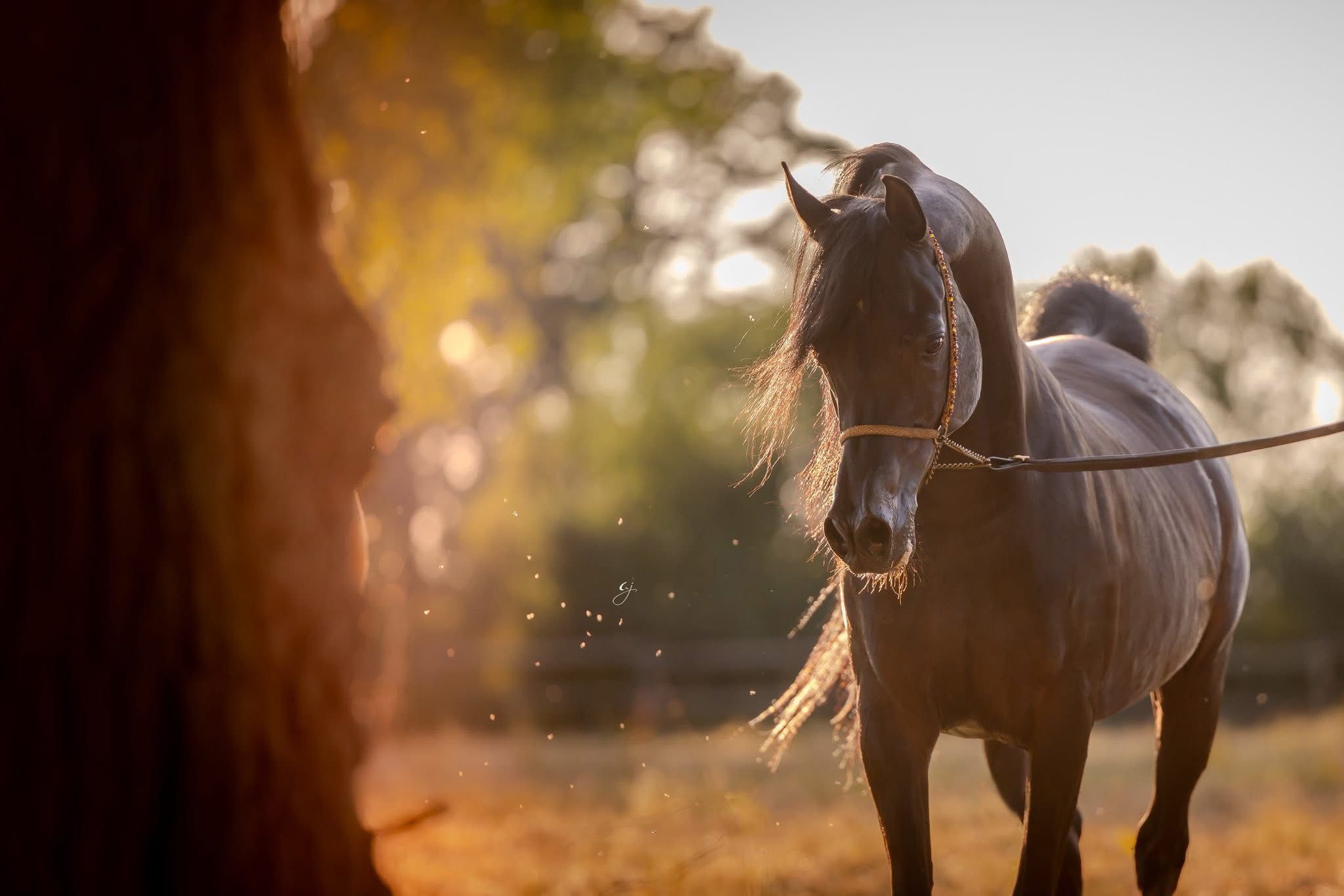
An authentic Arabian horse stands out by morphological traits unique to the breed:
- Short concave head (the “dished” profile) with broad forehead
- Large expressive eyes set low on the face
- Fine dilatable nostrils
- Arched neck, high attachment, elevated head carriage
- High-set tail carried like a flag - the breed’s signature
- Distinctive skeleton: 5 lumbar vertebrae (vs. 6), 17 pairs of ribs (vs. 18), 16 caudal vertebrae (vs. 18)
Average height: 14.1 to 15.1 hands (1.45–1.55 m at withers). Compact but athletic, weighing 380–450 kg.
To be declared a “purebred Arabian”, a horse must be registered in its national stud book (in France, AFCPSA), with a lineage tracing back to the founding stallions (Saqlawi, Kuhaylan, Mu’niqi, Hadban…).
Character and temperament
Three words sum up the Arabian horse:
- Intelligence - quick to learn, retains everything, anticipates the rider
- Sensitivity - reacts to the slightest signal; precise but cannot tolerate brutality
- Loyalty - once trust is established, forms a deep bond with its rider
It is a lively, energetic horse, often wrongly labeled “nervous”. In reality, it is simply highly responsive and expressive. Properly educated, it is calm, brave and reliable - even for less experienced riders. Roughly handled, it becomes tense and difficult - like any sensitive horse.
Coat colors
The Arabian horse comes in 5 main coat colors recognized by the stud book:
| Color | Detail |
|---|---|
| Bay | Most common. Brown-red body, black mane, tail and lower legs. |
| Chestnut | Reddish-copper coat, mane same color or lighter. |
| Grey | Born bay/chestnut/black, whitens with age. Highly prized in show. |
| Black | Rarer, sought after for its elegance. |
| Sabino / pinto | White markings - Spotted Arabian lineage. |
Palomino, cremello and isabella coats are not recognized in the Arabian horse - a horse advertised as such is likely not a purebred.
Arabian horse price
The price of an Arabian horse varies hugely depending on use, lineage and competition record:
- Leisure / trail : €3,000 – €8,000
- Confirmed riding / endurance horse : €8,000 – €20,000
- Show prospect or foal of prestigious lineage : €20,000 – €60,000
- Top stallion / international champion : €100,000 to several million
On top of purchase, expect €200 to €500 per month for full board (stable, feed, routine care).
Best disciplines
The Arabian horse excels in:
- Endurance - dominates international competitions
- Show and conformation - its beauty makes it a sought-after halter athlete
- Leisure, trail, light driving
- TREC, western, dressage entry levels
It is less common in high-level showjumping due to its moderate size, but is found at amateur levels.
Buy or breed
Looking to buy an Arabian horse or breed your mare to a quality stallion?
- Discover our five stallions available for service: Sultan AA, BM Dhakir Di Mar, SA Madison, SA Kareem, Avalon Crazy. All CA, SCID, LFS, OAAM negative, with verifiable AFCPSA papers. See also our Reproduction service for the full protocol.
- Browse our horses for sale - including the stallions Avalon Desert Eagle and MT Rohara Marvelous T, now available to purchase.
- Contact us - visits by appointment, personalized guidance.
Going further: our complete breeding guide - calendar, natural cover vs AI, fees, veterinary monitoring.
FAQ
What is the price of an Arabian horse?
An Arabian horse costs between €3,000 for a leisure mount and over €100,000 for an international show stallion. The usual range for a confirmed adult riding horse is between €8,000 and €20,000.
How do you recognize an Arabian horse?
By its short concave head, large eyes, high tail carriage, arched neck and moderate size (14.1–15.1 hh). Definitive authentication requires papers and stud book registration (AFCPSA in France, AHA in the US).
Is the Arabian horse suitable for beginners?
For any patient and respectful rider. It is particularly well-suited to endurance, show, leisure and TREC enthusiasts. Its sensitivity calls for a fine riding hand, but well-educated, it is a reliable horse - including for intermediate riders.
Why is it called a “purebred” Arabian?
Because the breed has been preserved without crossbreeding for thousands of years by the Bedouins. The term “purebred” refers to this genealogical purity, attested by the stud book, which only accepts descendants of the recognized founding stallions.
How long does an Arabian horse live?
It is one of the most long-lived breeds: 25–30 years on average, sometimes more with good care. Its desert-bred hardiness gives it a robust constitution.